Opinion article
Published in Edition 14
Beirut 2020: Walking in a loss adjuster’s shoes
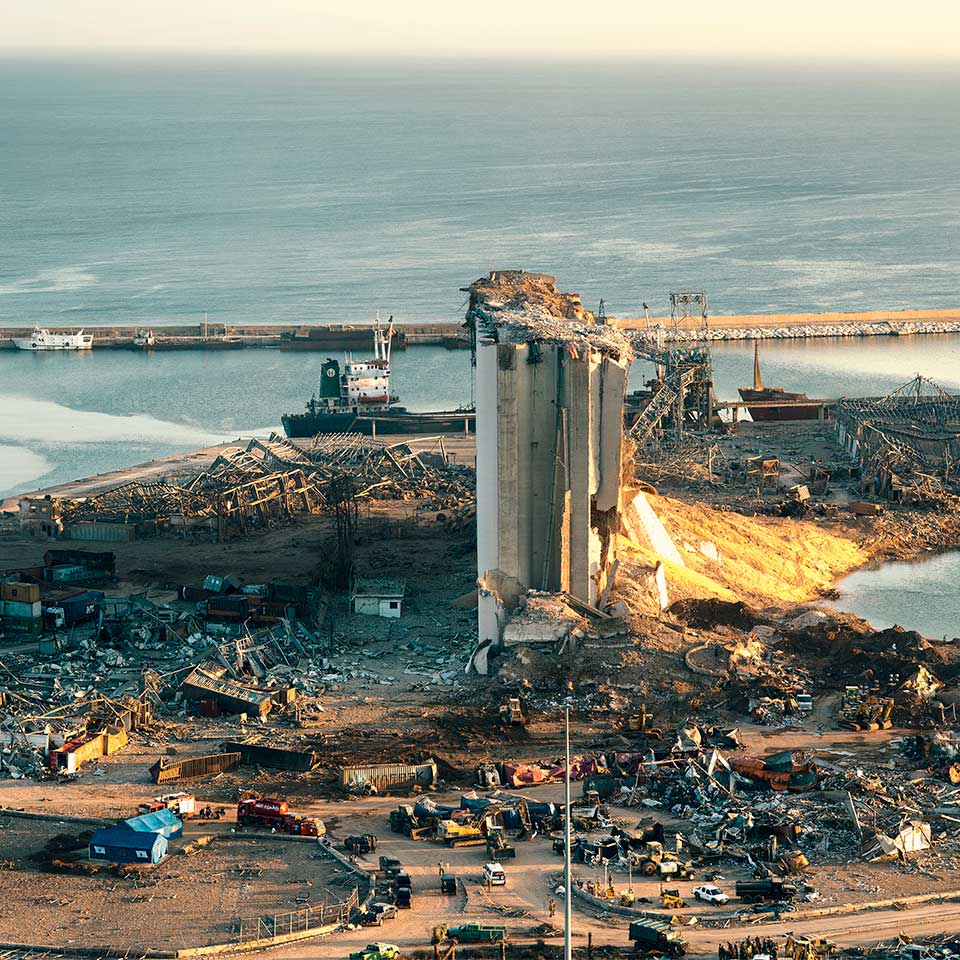
Working as an International Loss Adjuster for over 30 years I have experienced many exciting, rewarding and often challenging scenarios. That day, whilst writing another Preliminary Report for Underwriters, breaking news of a large explosion in the Port of Beirut popped up on my laptop.
I initially thought of the poor souls who may have lost their lives been injured or could have been locally affected in terms of losing loved ones, their jobs, homes and the general disruption this incident could cause in the immediate aftermath. I also realised at that moment that thousand of properties would have been affected.
With that in my mind contact was immediately made to my local Middle East office to find out what resources we had in the area, who we knew in terms of local Adjusters and of most importance who the local Insurers were. Delighted with the response the start of another Adjusting Adventure began.
Mobilising a small expeditionary team of Adjusters to immediately fly into Beirut was the first action. As the World was in the grips of the Covid-19 epidemic flights to the area were limited. However within 48 hours of the blast four of our Specialist Team had arrived in the country.
Challenge number one, the Covid test at the Airport. Not a pleasant experience but a necessary one to gain entry. Whilst navigating their way through the airport the Regional office were working on finding accommodation. Not an easy task as most of the hotels usually used for business had been extensively damaged by the blast and were shut. With a pioneering spirit one was found, damaged but open.
Whilst admin matters were underway (set up computer systems and a link to the Company IT Hub, amongst others) many telephone calls to local insurers, brokers, local adjusters and the international reinsurers in Europe commenced. Getting the message out to insurers and reinsurers was of most importance. This was by no means an easy task. What became quickly apparent, was that the country was in a state of shock, offices had been ordered to close down and a Beirut lockdown was in force. For this reason, the local team worked tirelessly to reach out to the markets directly or via the local adjusters to assure them of our joint effort to assist and take the pressure off a once in a lifetime crisis. In respect of the reinsurers, with the help of the local markets these players were then identified and dialogue with them in respect of reporting the on the ground situation and magnitude of the crisis. Communication with all involved at this time was key! Social media also played a very important part to let our clients know that we were on the ground, set up and ready to accept instructions working in tandem with local adjusters.
Whilst all of this logistical work was being performed, we were also conscious of the local Governmental Insurance Committee rules for international adjusters operating in Lebanon. With the help of local lawyers and our own corporate legal department and UK based lawyers within only a short time the appropriate licenses were granted.
Instructions started to be received, many coming via the local insurers, some from local adjusters who were overwhelmed and others directly from the reinsurers who ultimately held the most significant exposures. More adjusters were deployed as the size of the task was now in plain view to all involved. More logistical and adjuster management and introductions to the local players to be undertaken.
The economical fact opened up further challenges as Lebanon faces extreme currency devaluation. Exchange rates alter significantly by the day and banks limiting cash withdrawal together with black market exchange rates created a minefield for the adjusters on the ground. This is not uncommon in some countries, however makes the adjustment process even more complex in real time.
As the site surveys progressed Initial Reports started to be generated, the real adjusting work has just begun: capturing information, plans, drawings, contracts, supplier lists, repair contractors, consultants, architects, lawyers, accountants and experts, to name but a few.
Three months of hard work in an ever-changing environment confused by Covid -19, local civil unrest, political uncertainty, currency collapse, short-term lockdowns and curfews.
Nonetheless, the international Nat Cat experience we carry has put us on the road to providing the professional service demanded during such a high profile set of catastrophic events as we have seen in Beirut.
From the adjusters’ perspective, early response, resources, communication, adaptability, ingenuity, experience, support and flexibility are all key to successfully navigate the muddy waters of the aftermath of a devastating event such as the one occurred in Beirut in August 2020.
Last, but not least, one should always remember that in such extreme events there is a human consequence. Humility, respect, support and sympathy should never be far away when entering another country to adjust losses. We are, at the end of the day, part of a process, part of the team and therefore part of the solution.
AUTHORS
